The Mühlenteich lake
A special area of conservation in Georgsmarienhütte in Germany
Key Facts
How Oase water therapy products solved the problem of siltation, sludge formation, oxygen depletion, and fish mortality in a beautiful German nature reserve – while adhering to the Habitats Directive at every step.
- Project:
- Mühlenteich at Kloster Oesede
- Location:
- Georgsmarienhütte, Lower Saxony, Germany
- Type and size:
- Freshwater, 10,700 m2
- Problem:
- Siltation, sludge accumulation, oxygen depletion, fish death
- Product Applied:
- SchlixX Plus
- Results:
- The treatment helped prevent further fish deaths by increasing water depth to more than one metre after the first application, reduced sludge levels by an average of 34 cm despite ongoing re-siltation, and preserved the site's species-rich aquatic ecosystem
Project highlights:
Eco-friendly and low-impact treatment in a nature reserve (Special Area of Conservation), without falling foul of local reservation directives.
Long-term support measures through intensive monitoring over a decade.
|
The starting point: Accelerated siltation and oxygen decline in a protected lake
An idyllic nature reserve at risk of disappearing
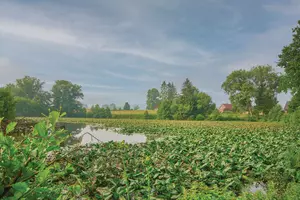
The lake Mühlenteich at Kloster Oesede in the town of Georgsmarienhütte is located in the middle of a European nature reserve, surrounded by stunning wetlands. The diversity of its animal and plant species makes it protected by the Habitats Directive – it is what's known as a Special Area of Conservation, or SAC for short.
Increasing periods of drought and sediment growth were causing the water level to sink steadily, which eventually led to entire areas silting up. For several years in a row, fish were regularly dying due to the smaller water volume and the consequent lack of oxygen in the water.
To preserve the lake as a nature reserve in accordance with the Habitats Directive – as well as preserving its value as a recreational area – this process needed to be stopped with minimal impact and lasting effect.
Avoiding further damage in a sensitive conservation area
After careful examination, the first idea – dredging the lake – was rejected, because the use of heavy machinery would have damaged the land too much. It was feared that nature and the local biodiversity would no longer be able to self-regenerate. The aim was therefore to find an effective but low-impact solution that would preserve the entire biotope of the Mühlenteich. That's where Oase came in.
The Solution
Long-term lake therapy for the delicate SAC
The solution was obvious to the Oase team: lake therapy using SchlixX Plus, which ensures natural degradation of the biomass that would otherwise continue growing indefinitely.
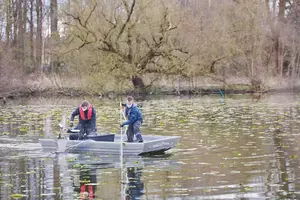
After an intensive environmental impact assessment, SchlixX Plus was first applied to selected places in September 2012, initially just to observe changes in the sediment and any possible effects on the overall biotope. Further applications followed in 2013, 2014, 2018, 2019 and 2020 with the aim of further reducing the sludge layer and compensating for new siltation that naturally occurs.
Responsible action, close observation, and long-term care
An extensive monitoring system was set up to document the results in-depth over the long term. Since 2013, samples have been taken continuously at ten separate measuring points in order to detect changes in the sludge thickness and examine whether the biocomponents (plankton, macrophytes and macrozoobenthos) have been affected in any way. As a delicate, protected ecosystem, it’s vital that Mühlenteich is cared for thoughtfully and responsibly.

The Results
Reduced sludge, a recovered habitat, and preserved biodiversity
The successes after a decade are clear to see. After just the first application of SchlixX Plus, the measured water depth rose to above 1m again in several places. The monitoring measures in 2013 estimated the sludge layer to be 83cm, but by 2020 it was down to only 53cm. Despite new sediment formation of about 3cm each year – due in part to the decomposed plant material of the yellow water lilies covering the surface of the pond – the sediment has been reduced by a third overall with just five applications.
Less sludge means a greater volume of more valuable water available. The sustainable water therapy using SchlixX Plus has therefore not only successfully stopped the siltation process – the increased depth of the water has also created a more oxygen-rich habitat for the fish. There have been no excess fish deaths since, and the fish population has recovered very well thanks to the significantly improved conditions.
Furthermore, studies have shown that there have been no negative effects on the biocomponents of plankton, macrophytes and macrozoobenthos. During their on-site visits, most recently in 2020, experts were able to observe a species-rich biotope with higher distribution of amphibians and dragonflies. No wonder SchlixX Plus has now won the German Award for Sustainability.
Request a free consultation
Complete the form and one of our specialists will contact you to arrange a convenient time for a discussion.