Cycling an aquarium
Before you start adding fish to your aquarium, it is best to let the aquarium “cycle.” A “cycled” aquarium is one that has an established population of the bacteria that convert ammonia to nitrite and nitrite to nitrate. Ammonia and nitrite levels in your tank reach 0 ppm (parts per million) – the length of time it takes to fully cycle can vary. Most aquariums will eventually cycle on their own, however the loss of fish can be significant if the process is not controlled because ammonia and nitrite are highly toxic to aquarium fish.
The nitrogen cycle begins when nitrogenous waste such as fish waste, uneaten food, and decaying plant matter gets broken down and releases Ammonia (NH3/NH4 – very toxic to fish).
Ammonia and other nitrogenous waste is converted by oxidizing bacteria into nitrite (NO2 – toxic to fish).
Nitrite is converted when bacteria is metabolized into nitrate (NO3 – not as harmful to fish). Maintain nitrite levels below 20 ppm, ideally 5 to 10 ppm.
Plants are fertilized by the nitrates. Through a combination of decay and excretions from fish that eat the plants, waste matter generates ammonia to continue the cycle.
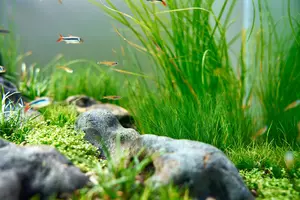
There are different methods to cycle an aquarium with minimal distress to fish. Three common methods are fish-less cycling where a source of nitrogen (that is not a fish) is introduced in the aquarium, fish cycling which requires very frequent water changes and a good water conditioner, and silent cycling where you use plants to process the Ammonia and Nitrites. It is important to do your research to determine which is the best method for you and your aquarium. No matter which method you choose you will need a good testing kit for Ammonia, Nitrites and Nitrates.